
Build India’s Circular Battery Economy Now: Paving the Way for Sustainable EV Growth for Lithium-ion Battery Manufacturers in India

Updated: Apr 1

India’s electric vehicle (EV) market is experiencing remarkable growth, driven by consumer adoption, EV-friendly policies, and expanding local production. But as EV adoption surges, one crucial question arises—what happens to batteries at the end of their lifecycle? Without a strong circular ecosystem, the benefits of electrification may be overshadowed by battery waste and raw material dependence. This is where Lithium-ion Battery Manufacturers in India play a pivotal role, as the move toward recycling, reusing, and recovering materials becomes essential for sustainability and cost efficiency.
India must now accelerate its shift toward a circular battery economy—ensuring batteries are collected, refurbished, recycled, and reintegrated into the supply chain. This approach reduces import dependency, maintains resource value, and supports the long-term EV vision.
From Intent to Action: Policies Driving the Circular Shift for Lithium-ion Battery Manufacturers in India
2025 marks a landscape transformation as India moves from policy intent to action in EV battery recycling. Extended Producer Responsibility (EPR) places accountability on OEMs and Lithium-ion Battery Manufacturers in India, ensuring traceability from production to disposal. With this regulatory push, private players and startups are innovating battery recycling technologies, recovering critical metals like lithium, cobalt, and nickel domestically—reducing both cost and supply risk.
A major leap forward is the adoption of digital battery passports, storing data about battery composition, usage history, and health. These records will help OEMs and fleet operators optimize second-life applications, safe degradation, warranty, and recovery systems—creating a transparent and data-driven supply chain.
You Can Read Also: The Next Battery Revolution: How India is Powering Beyond Lithium-Ion
Quantifying the Challenge: The Recycling Demand by 2030
By 2030, India is expected to retire hundreds of thousands of EV batteries every year, creating a demand surge for efficient recycling infrastructure. To manage this scale, India needs EPR-enabled collection networks extending beyond metros to Tier-2 & Tier-3 cities. Setting up collection hubs near battery manufacturing clusters can reduce logistics costs and enable seamless retrieval and recycling cycles.
A well-organized circular structure ensures materials remain in circulation rather than ending up as waste—maximizing recovery value.
Collaborative Pathways: OEMs & Recyclers Must Work Hand-in-Hand
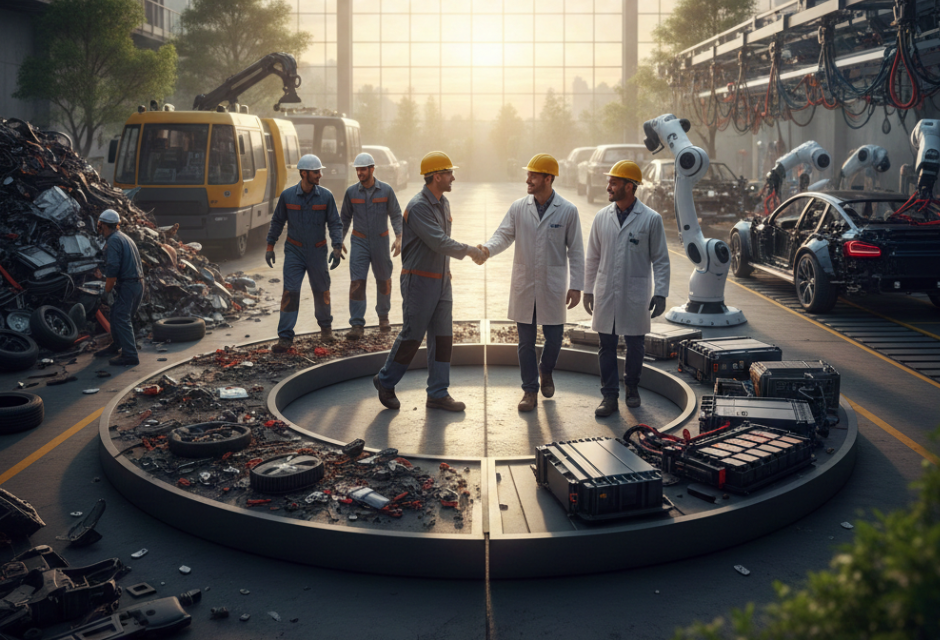
To accelerate circular adoption, OEMs and Lithium-ion Battery Manufacturers in India can explore strategic models such as:
1. Co-creating Recycling Parks
Partner with recyclers and municipalities to build recycling parks close to EV and battery production hubs. This reduces transport emissions, boosts dismantling efficiency, and standardizes safety protocols.
2. Strategic Offtake Contracts
Instead of setting up their own recycling plants, OEMs can collaborate with specialized recyclers through long-term offtake agreements. This capex-light model promotes specialization and scale simultaneously.
Such collaborations empower manufacturers to prioritize innovation and production while ensuring environmental accountability.
The Sustainability Imperative
Transitioning to a circular battery economy is not just compliance—it is sustainability, strategy, and national advantage. By reclaiming materials through recycling, India reduces import dependence for critical minerals, cuts carbon impact from mining, and preserves ecological balance. Digital traceability boosts accountability across recycling channels, making every battery count.
You Can Read Also: How to Maintain Your Lithium-ion Battery for a Longer Life
Choose Neuron Energy For Your Lithium-ion Batteries, Wanna know Why ?
As one of the leading Lithium Ion Battery Manufacturers in India, we’re driven by a vision to make India greener and mobility smarter. Neuron Energy is accelerating the shift to clean energy through advanced battery technologies and innovative energy storage solutions. Our reliable lithium-ion batteries, power systems, and smart energy products power electric two-wheelers, three-wheelers, LCVs, and more — helping businesses, communities, and industries move toward a cleaner, more sustainable future. |   |
Conclusion: Powering the Future Responsibly
India stands at a defining moment in electrified mobility. For long-term success, policymakers, OEMs, recyclers, fleet owners and Lithium-ion Battery Manufacturers in India must work collectively toward a circular battery ecosystem. Through responsible recycling, smart policies, and technology-driven traceability, India can become a global leader in sustainable EV battery management.
A circular battery economy is not a choice—it is the future.
With collaboration, innovation, and shared responsibility, India can turn battery waste into valuable resources—powering progress while protecting the planet.
FAQs
1. What role do Lithium-ion Battery Manufacturers in India play in the circular battery economy?
Lithium-ion Battery Manufacturers in India are responsible for production, lifecycle management, recycling collaboration, and ensuring sustainable material recovery for EV batteries.
2. Why is battery recycling important for Lithium-ion Battery Manufacturers in India?
Recycling helps Lithium-ion Battery Manufacturers in India recover valuable metals, reduce import dependence, lower production costs, and support eco-friendly EV growth.
3. How can Lithium-ion Battery Manufacturers in India benefit from digital battery passports?
Digital battery passports improve traceability, track battery health, prevent waste, and enable second-life usage—helping manufacturers optimize warranties and resources.
4. What policies support Lithium-ion Battery Manufacturers in India to adopt circular practices?
Extended Producer Responsibility (EPR) regulations require manufacturers to manage battery disposal, promote recycling networks, and collaborate with recycling startups.
5. How does a circular battery economy impact the future of Lithium-ion Battery Manufacturers in India?
A circular battery economy drives cost efficiency, sustainability, and resource security, enabling Lithium-ion Battery Manufacturers in India to scale with global EV demand.


I found this online resource while searching for practical lifestyle ideas, and I thought it was worth sharing: https://infowomenspace.com