
Building Batteries in India: EV Battery Manufacturers in India Solving for Local Needs at Scale

Updated: Apr 2
Anyone working closely with EVs in India learns this early: batteries behave very differently once they face real operating conditions. Heat rises faster, loads fluctuate, and usage cycles are longer and less predictable. Designs that perform well in controlled global markets often need rethinking here.
That’s why building batteries in India is not just about localisation. It’s about learning faster, designing better, and enabling EV battery manufacturers in India to innovate for real-world challenges.

Why Local Manufacturing Matters for EV Growth:
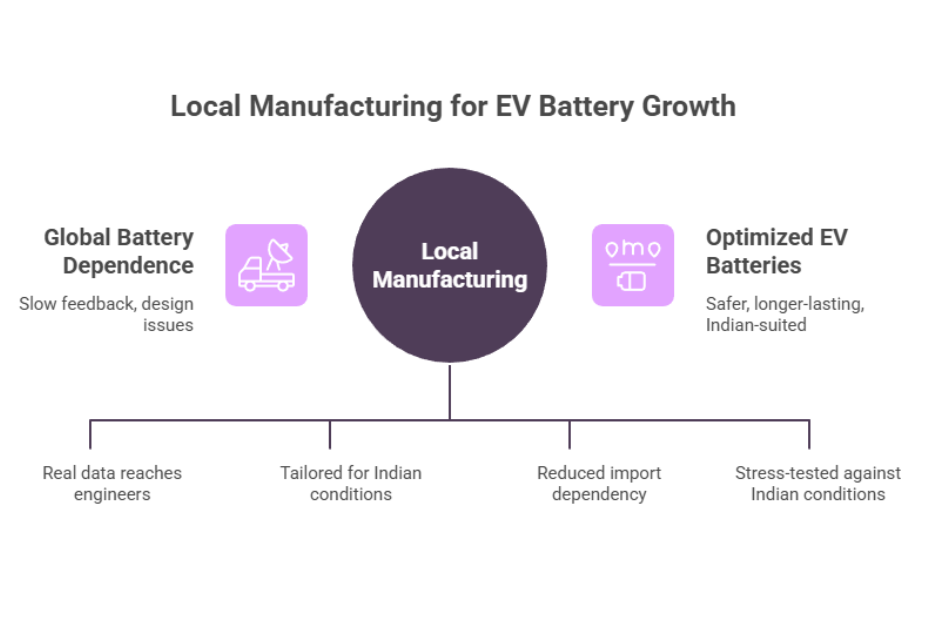
For EV battery manufacturers in India, proximity to the market dramatically shortens feedback loops. When batteries are built close to end users:
Field data reaches engineering teams faster
Design issues are identified earlier
Improvements are implemented without long global supply delays
Instead of relying on assumptions derived from overseas markets, EV battery manufacturers in India can evolve their products using real Indian usage data—across two-wheelers, three-wheelers, passenger vehicles, and commercial fleets.
This localisation improves not just performance, but safety and lifecycle reliability.
You Can Read Also: Extending Value: How EV Battery Manufacturers in India Are Giving Batteries a Meaningful Second Life
Scale Is Arriving Faster Than Expected:
India’s EV ecosystem is entering a phase where scale will test every component of the system. According to industry projections, lithium-ion battery demand in India is expected to grow at a CAGR of 35–40% through 2030, driven by electric mobility and energy storage expansion.
For EV battery manufacturers in India, this rapid growth means:
Small design inefficiencies multiply at scale
Thermal management becomes mission-critical
Durability and cycle life directly impact profitability
Predictable performance outweighs peak specifications
As demand accelerates, EV battery manufacturers in India must prioritize robust engineering over theoretical benchmarks. High ambient temperatures, dense urban traffic, and variable charging patterns require solutions designed specifically for Indian conditions.
Engineering for Indian Operating Conditions
India presents a unique set of challenges:
High summer temperatures exceeding 45°C
Heavy stop-start urban traffic
Irregular charging infrastructure in certain regions
Long daily duty cycles for commercial vehicles
Global battery designs often require modification to perform reliably here. This is where EV battery manufacturers in India gain a strategic advantage.
By designing for:
Advanced thermal management systems
Optimized Battery Management Systems (BMS)
Improved structural safety and vibration resistance
Real-world duty cycle testing
Manufacturers can deliver batteries that are safer, longer-lasting, and better suited for Indian mobility needs.
Supply Chain Resilience and Policy Support
Local manufacturing strengthens the overall ecosystem. For EV battery manufacturers in India, domestic production reduces exposure to:
Import dependency
Currency volatility
Global logistics disruptions
Extended lead times
Government initiatives like the Advanced Chemistry Cell (ACC) Production Linked Incentive (PLI) scheme aim to create 50 GWh of domestic cell manufacturing capacity. This policy push is accelerating investment and innovation across the value chain.
With stronger supply chains and faster iteration cycles, EV battery manufacturers in India can improve quality control, production yields, and time-to-market.
Speed of Iteration: The Real Competitive Edge
As EV adoption transitions from early growth to industrial scale, learning speed becomes a differentiator.
When testing and validation happen locally:
Batteries are stress-tested against Indian temperatures from day one
Road vibration and terrain challenges are accounted for early
Fleet feedback loops refine design quickly
This rapid iteration enables EV battery manufacturers in India to create products that are not just compliant—but truly optimized for Indian roads and consumers.
The Role of EV Battery Manufacturers in India in the Energy Transition

Beyond mobility, battery storage is becoming essential for renewable energy integration and grid stability. As India expands its solar and wind capacity, demand for energy storage solutions will rise significantly.
EV battery manufacturers in India are uniquely positioned to support:
Grid-scale storage systems
Commercial energy backup solutions
Residential battery storage
Integrated EV charging and storage infrastructure
Their ability to design locally and scale efficiently will shape the next decade of India’s clean energy transformation.
Choose Neuron Energy For Your Lithium-ion Batteries, Wanna know Why ?
As one of the leading Lithium Ion Battery Manufacturers in India, we’re driven by a vision to make India greener and mobility smarter. Neuron Energy is accelerating the shift to clean energy through advanced battery technologies and innovative energy storage solutions. Our reliable lithium-ion batteries, power systems, and smart energy products power electric two-wheelers, three-wheelers, LCVs, and more — helping businesses, communities, and industries move toward a cleaner, more sustainable future. |   |
Conclusion
Building batteries in India is more than a manufacturing shift—it is an engineering necessity. Real-world Indian conditions demand smarter thermal design, stronger durability standards, and faster innovation cycles.
As EV adoption accelerates, EV battery manufacturers in India will play a defining role in ensuring safe, scalable, and reliable electrification. Competitive advantage will belong to those who can learn faster, iterate locally, and design products grounded in Indian realities.
The future of mobility and energy storage in India will be built not just with batteries—but with batteries engineered for India, by India.
FAQs
Why are EV battery manufacturers in India important for the EV ecosystem?
EV battery manufacturers in India enable localized design, faster feedback loops, and better adaptation to Indian climate and road conditions, ensuring improved safety and performance.
How do Indian weather conditions impact EV batteries?
High temperatures, heavy traffic, and long duty cycles increase thermal stress. EV battery manufacturers in India must design advanced cooling and battery management systems to handle these challenges.
What government initiatives support EV battery manufacturers in India?
Programs like the ACC PLI scheme promote domestic cell manufacturing, reduce import dependence, and strengthen India’s EV supply chain.
How does local manufacturing improve battery quality?
Local production allows quicker iteration, better quality control, faster problem resolution, and real-world testing under Indian conditions.
What is the future outlook for EV battery manufacturers in India?
With projected demand growth of 35–40% CAGR through 2030, EV battery manufacturers in India are expected to scale rapidly, supporting both electric mobility and renewable energy storage markets.


Comments