
Why 2026 Will Be the Year of Application-Specific EV Batteries
- Neuron Energy

- 7 hours ago
- 3 min read
For years, the EV battery conversation was dominated by a single idea: standardization. Build one battery architecture. Scale it across multiple use cases. Drive down costs through volume.
But as we move deeper into 2026, the era of application-specific EV batteries 2026 is clearly emerging. This approach is reshaping how batteries are designed, manufactured, and deployed across the mobility ecosystem.
Because not all electric mobility is the same. And increasingly, neither are the batteries that power it.
1. One Size No Longer Fits All
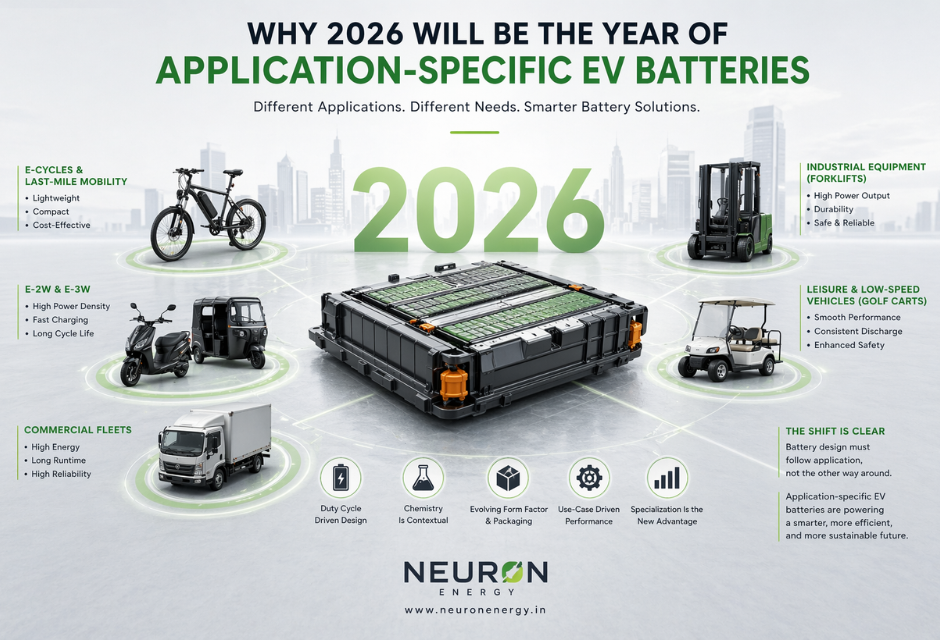
The EV ecosystem has expanded far beyond passenger vehicles. Today, it includes:
E-cycles and last-mile mobility
Electric two- and three-wheelers
Commercial fleets
Industrial equipment like forklifts
Leisure and low-speed vehicles like golf carts
Each of these operates in completely different conditions:
Different load requirements
Different duty cycles
Different charging patterns
Different cost sensitivities
This is exactly why application-specific EV batteries 2026 are becoming essential, because a single standardized battery can no longer efficiently serve all segments.
Trying to power all of them with a uniform solution leads to inefficiencies. In 2026, the shift is clear: battery design must follow application, not the other way around.
You can also read : EV Battery Manufacturers in India Solving for Local Needs at Scale
2. Duty Cycles Are Driving Design Decisions
One of the most important factors shaping battery innovation is the duty cycle—how a battery is used over time.
For example:
Fleet vehicles run continuously for long hours
E-cycles operate in short bursts with frequent stops
Forklifts require high power output in controlled environments
Golf carts need smooth, consistent discharge
Each scenario demands different optimization in:
Energy density
Power output
Thermal stability
Cycle life
This shift is accelerating the demand for application-specific EV batteries 2026, where every design decision is based on real-world usage patterns.
3. Chemistry Is Becoming Contextual
The idea of a “best battery chemistry” is fading.
Instead, 2026 is seeing the rise of context-driven chemistry selection:
LFP is widely used for safety, longevity, and cost efficiency
High-performance chemistries are reserved for demanding applications
Emerging alternatives are being tested for scalability and affordability
This means the focus is no longer on one dominant chemistry, but on matching chemistry to application needs—another core principle of application-specific EV batteries 2026.
4. Form Factor and Packaging Are Evolving
Beyond chemistry, physical design is now a major innovation driver.
Battery packs are being engineered for:
Compact mobility systems
Space-constrained vehicles
Swappable battery ecosystems
Modular energy platforms
This flexibility is critical for scaling application-specific EV batteries 2026, enabling seamless integration across multiple vehicle platforms.
5. Performance Expectations Are Becoming Use-Case Driven
Different users now expect different outcomes:
Fleet operators want uptime and predictability
Individual users value convenience and low maintenance
Industrial users prioritize durability and safety
Leisure users expect smooth performance
This shift is pushing manufacturers toward experience-based engineering, a key pillar of application-specific EV batteries 2026 development.
6. The Competitive Advantage Is Moving to Specialization
As the market matures, specialization is becoming a key differentiator.
Companies that succeed will:
Design for specific environments
Optimize for real-world usage patterns
Build deep expertise in targeted segments
In 2026, success will not come from being everything to everyone. It will come from delivering excellence through application-specific EV batteries 2026 strategies.
You can also read : EV Batteries to Energy Ecosystems: The Real Opportunity of 2026
What This Means for the Industry
The EV battery landscape is entering a more precise and intelligent phase.
Scale still matters—but precision matters more.
Understanding:
How a battery is used
Where it is used
What it is expected to deliver
…is becoming just as important as manufacturing capability.
For companies like Neuron Energy, this is a major opportunity to lead the shift toward specialized energy systems.
Learn more: https://www.neuronenergy.in/
Conclusion
The future of EV batteries is no longer about universal solutions. It is about intelligent customization.
Application-specific EV batteries 2026 represent a fundamental shift in how energy storage is designed and deployed. From mobility to industrial applications, every segment now demands a tailored approach.
Companies that embrace this shift early will define the next era of EV innovation—where performance, efficiency, and real-world usability come together through purpose-built battery systems.
FAQS
Q1. What are application-specific EV batteries 2026?
These are EV batteries designed for specific applications like e-cycles, fleets, forklifts, and other electric mobility systems instead of a one-size-fits-all solution.
Q2. Why are application-specific EV batteries important in 2026?
They are important because different EV applications have different power, usage, and performance needs, so customized batteries work more efficiently.
Q3. How do application-specific EV batteries improve performance?
They improve performance by optimizing design, chemistry, and capacity based on how and where the battery will be used.
Q4. Are EV batteries becoming more specialized in 2026?
Yes, in 2026 the industry is moving toward more specialized and use-case-based battery solutions instead of standard designs.
Q5. What factors influence EV battery design today?
Battery design depends on usage patterns, vehicle type, power requirements, safety needs, and cost efficiency.



Comments